Book a tour
Explore Ireland's Ancient East, step inside Newgrange, the 5,000-year-old monument or take a moment on top of the mystical Hill of Tara.
Ireland’s Ancient East brings history to life against a backdrop of green fields in the Boyne Valley and mountain wilderness in Wicklow.
Ireland’s Ancient East
- Ancient Ireland – Newgrange, Knowth, Dowth, Fourknocks, Hill of Tara and Loughcrew.
- Early Christian Ireland – Monasterboice, Kells, Glendalough, Mellifont Abbey and Bective Abbey.
- Medieval Ireland – Trim Castle.
- Ireland’s Great Houses – Slane Castle, Oldbridge House, Powerscourt House and Russborough House.
In this section


Ancient Ireland
There are many monuments that are older than the pyramids, set in an ancient green landscape – passage tombs, dolmens and Stone Age observatories that are found throughout Ireland’s Ancient East.
Visitors can wonder at the meanings behind the largest concentrations of carved Stone Age artwork and Celtic gold artifacts in Western Europe as well as hear from the locals themselves the stories that infuse this landscape of ancient warriors and Celtic druids.
In the Boyne Valley there are a collection of prehistoric ceremonial sites that connect the lives and deaths of Stone Age Man who lived here to the seasons of the land in which they lived.

Early Christian Ireland
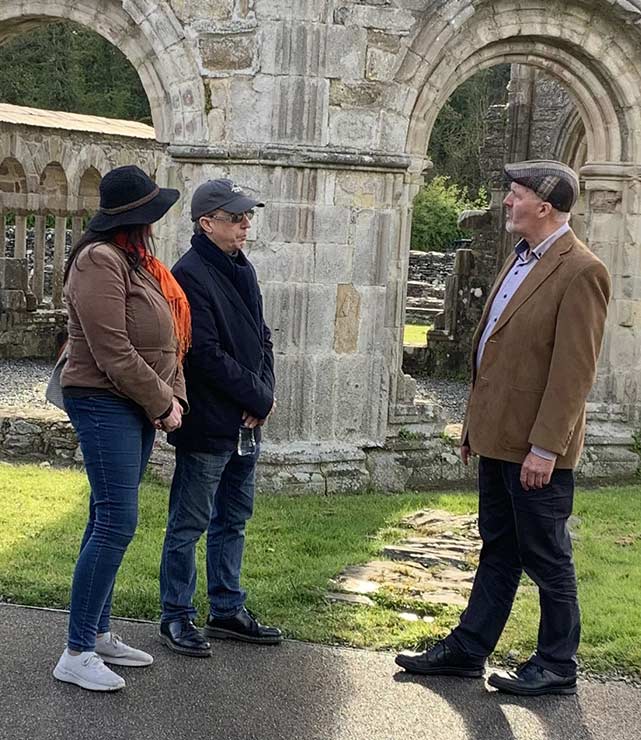
Step into the Golden Age of Saints and Scholars and visit the university and monastery sites where Ireland’s pioneering saints and monks wrote some of the world’s greatest illuminated manuscripts, before spreading their learning and spirituality throughout a Europe locked in the Dark Ages.
Stand on the Hill of Slane where St. Patrick lit the first paschal fire, then stand on the Hill of Tara where the Druids witnessed Patrick’s paschal fire. Visit Glendalough, the Monastic City founded by St. Kevin in the 6th century.


Medieval Ireland
Explore the pathways of Medieval Ireland and uncover a rich tapestry of tales from this turbulent time.
From the Viking Triangle of Ireland’s oldest city, Waterford, lush river valleys lead to the beautifully preserved Medieval City of Kilkenny and beyond.
The fortresses and castles built to protect the land and its occupants are evident everywhere in the region. For example, Hugh de Lacy’s magnificent Norman Castle still dominates the landscape at Trim.

Ireland’s Great Houses
Discover the stories of a time of contrasts which shaped the lives of the now settled conquerors of Ireland and those they ruled over.
Experience what life was like in the 18th and 19th centuries. Lavish gardens, opulent houses and market towns are all there to explore including the great estates at Slane and Oldbridge in the Boyne Valley, Powerscourt and Russborough in Wicklow.


Ireland’s Ancient East – Interesting Facts
- Muiredach’s Cross, Monasterboice in the Boyne Valley is Ireland’s most beautiful High Cross and West Cross is the tallest remaining Celtic high cross in Ireland.
- Newgrange and Knowth in the Boyne Valley are the best-known Irish passage tombs dating to 3,200BC. Newgrange is the oldest known deliberately orientated structure in the world.
- Loughcrew in the Boyne Valley is the oldest cemetery in the world and tells of Ireland’s Neolithic cultures. One legend has it that the so-called burial mounds were created by a witch flying overhead and dropping pebbles on the landscape.
- Trim Castle in the Boyne Valley is Ireland’s Largest Anglo-Norman Castle. It is also the place where the film Braveheart was shot.
- Wicklow derives its name from the Old Norse name meaning ‘Vikings Meadow’.
- Wicklow is colloquially known as the Garden of Ireland.
- Lough Tay in Co. Wicklow was the filming location for the original ‘Vikings’ series and now the ‘Vikings: Valhalla’ series.

Book a Private Tour
Email: BoyneValleyTours@gmail.com | Phone within Ireland: 087 8354805 | International or WhatsApp: +353 87 8354805 | USA/Canada: 011 353 87 8354805
View our tours