This website uses cookies to help deliver its services. By using this website, you agree to the use of cookies as outlined in our Privacy Policy.


Monasterboice is one of Ireland's earliest Christian sites, the name derives from the Irish 'Mainistir Bhuithe' (monastery of Buite).
St. Buite was an Irish monk and follower of St. Patrick, it is said that in 480, St. Buite on a return trip from Rome raised Nechtan Morbet, the King of Pictland (Scotland), from the dead.
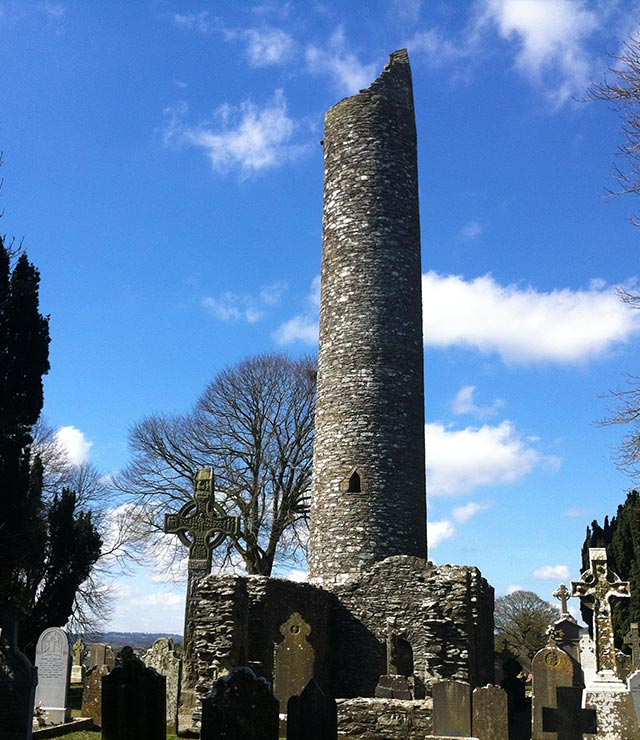
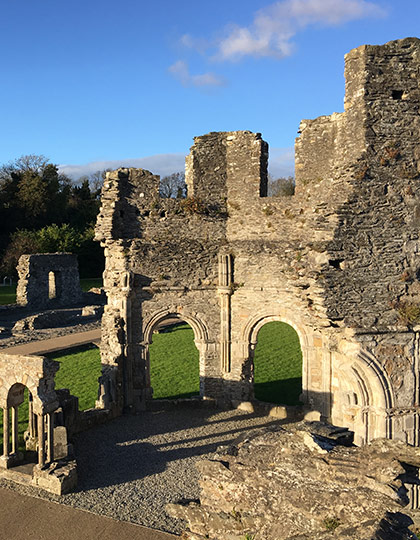
At Monasterboice today you can see the Round Tower, the magnificent High Crosses and the the remains to two churches.
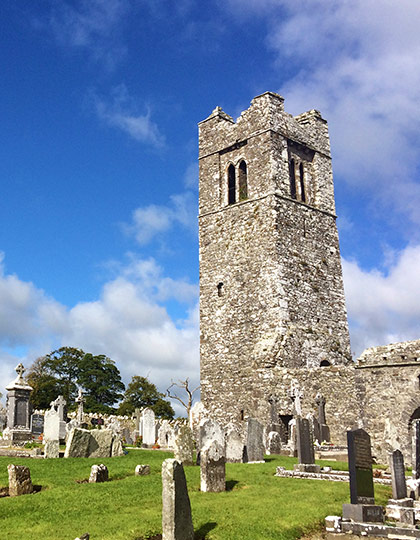
Although round towers were originally thought to have been places of refuge from Vikings, the Irish name ‘cloic theach’ meaning a bell house suggests they also served as bell towers. The tower at Monasterboice was burned in 1097, destroying the monastic library and other treasures. However, it is still in excellent condition, though without its conical cap. It is the second tallest round tower in Ireland.
The Vikings occupied the site for a period until they were routed by Domhnall, King of Tara, in 968. St. Buite’s monastery remained an important centre of spirituality and learning for many centuries until the establishment of the nearby Mellifont Abbey in 1142.
At Monasterboice there are two of the finest High Crosses (Celtic Crosses) in Ireland – the South Cross (or Cross of Muiredach) and the West Cross (or Tall Cross) – which date from the 10th century. The sandstone crosses are finely carved and depict biblical scenes from the Old and New Testaments. Today the image of the High Cross is recognized internationally, not merely as a religious icon but also as a symbol of Irish cultural heritage.
In this section
Here is Monasterboice
From a distance, the first you see of Monasterboice is a tall round tower, jagged at the top, missing its original conical roof.
Irish High Crosses were carved between the eight and twelfth centuries. Early crosses were decorated with simple geometrical reliefs, but in the ninth and tenth centuries biblical scenes were introduced, meant to be “read” in a particular order, usually from the ground up. Interlaces, geometrical motifs, entangled creatures—what we often think of as “Celtic” art is derived from the style found all across northern Europe, Germany, Scandinavia and Anglo-Saxon England. It is quite possible that the High Crosses were originally coloured or brightly painted. Although the scenes carved on the High Crosses may have been edifying “sermons in stone”—similar to the “sermons in glass” found in stained-glass windows—the High Crosses were also status symbols for the monasteries and their patrons.
Monasterboice has three High Crosses, two of which are quite impressive. The South or Muiredach’s Cross is 5.5 m (17 ft 8 in) high and is one of the most perfect in Ireland—a true national treasure. It is named after an abbot, probably Muiredach mac Domhnaill, who died in 923 CE and is commemorated in carving on the base. It is carved from a single block of sandstone attached to a pyramidal base; a decorative sandstone capstone sits on top. The entire surface of Muiredach’s Cross is covered with ornate designs based on an underlying geometrical grid—a way in which the skilled stone carvers gave visual representation to the geometrical matrix that underlies reality.
Detailed figural sculptures of biblical stories (both Old and New Testaments) decorate the cross on the east and west sides; geometric and interlace ornamentations are carved on the narrower north and south sides. A series of zodiacal figures adorn the base. Its capstone is a tiny roofed building or miniature oratory, perhaps representing a reliquary. It includes a depiction of St Paul and St Anthony in the (Egyptian) desert.
The east side of Muiredach’s cross, as is usual for High Crosses, focuses on images from the Old Testament. It begins at the base with a scene from the Garden of Eden, then moves up to Cain and Abel, David and Goliath, Moses, and the Magi. Within the wheeled center and extending through both arms is Christ at the Last Judgment. According to Nigel Pennick, this image is “based on the iconography of the resurrected Egyptian god, Osiris. Christ is holding a cross and Irminsul-staff in the Osirian position, and on his head is an eagle that resembles the crown of Egyptian gods and pharaohs”. Pennick interprets the figure to the left of Christ as Pan with his pipes, the harp-playing figure on the right as either King David or Apollo.
The west side is devoted, more or less, to the life of Christ, beginning at the base (above the inscription and some charming Celtic cats) with his arrest at Gethsemane and continuing upward to his crucifixion (complete with soldiers mocking Christ) and then his Resurrection. On the north side, under the outstretched cross-arm, is a depiction of the Hand of God (Dextera Dei) with a nimbus of power behind it, above intertwining vines with human heads.
The West Cross or Tall Cross stands near the north church and the round tower. It is 7m (23ft) high, the tallest High Cross in Ireland or anywhere else. It also is covered with biblical scenes, though they are badly eroded. On the east side of the crosshead is a carving of David killing a lion with a hurley stick and ball—the earliest depiction of the game in Ireland. The west side includes another crucifixion scene. The North Cross, which has been heavily reconstructed, stands to the north, next to what remains of an old stone sundial.
Monasterboice is in a delightful rural setting, surrounded by a low stone wall and numerous trees. It is neither neglected nor over-developed. There is no charge for entry. Visiting Monasterboice is like discovering a new friend—but one that you feel you have known for a long, long time, and one that you look forwarded to seeing again.
Source Powerful Places in Ireland
Show More
This location features in the following tours
When you book with Boyne Valley Tours you will experience over 5,000 years of Irish Culture and History. Choose from our tours across the Boyne Valley as well as popular Wicklow Tours and Highlights.



Book a Private Tour
Email: BoyneValleyTours@gmail.com | Phone within Ireland: 087 8354805 | International or WhatsApp: +353 87 8354805 | USA/Canada: 011 353 87 8354805
View our tours